
" height="15.714285714285712px" id="HuUY1YOMY" transform="translate(2 4)" width="20px"/></svg>)
" height="18px" id="smOoqr7Ui" transform="translate(3 3)" width="18px"/></svg>)
APL eZRx – B2B Marketplace for PT Anugerah Pharmindo Lestari | Case Study
Digitalizing a fragmented, unintegrated manual process into a unified B2B marketplace for pharmaceutical distributors and their retail customers.

Client:
PT Anugerah Pharmindo Lestari (APL)
Category:
Web & Mobile App
My Role:
UI/UX Designer
Tools
Adobe XD, Miro
A single platform to manage orders, stock, and deliveries, built for businesses that had never done it digitally before.
PT Anugerah Pharmindo Lestari is a pharmaceutical distributor with a wide network of pharmacy, supermarket, and minimarket clients. Despite the scale of their operations, their sales transactions ran almost entirely through various channel : WhatsApp messages, phone calls, and Excel files passed back and forth between sales reps and customers.
To handle that, we build eZRx, a B2B marketplace accessible on both web and mobile, giving APL's customers a proper digital space to place orders, monitor stock, and track deliveries without relying on manual coordination.
My Role & Scope
I joined as one of two UI/UX designers responsible for both the web and mobile versions of the platform. Partway through the project, I took on sole ownership of both, handling design from ideation through to developer handoff across multiple project phases and feature expansions. Throughout, I worked alongside a Business Analyst, Project Manager, QA engineers, and the front-end development team.
Beyond design files, I also contributed HTML and CSS during the early sprint phases, working alongside the front-end developer to help speed up the handover process. Having a designer who could write markup directly reduced the gap between design and implementation from the start.

What's the issue?
Orders were placed through WhatsApp. Stock availability was unknown and bulk purchases lived in Excel.
For APL's B2B customers (pharmacies and retailers placing regular, often large orders) the existing process created constant friction. There was no single place to check what was in stock before ordering. Order confirmations happened over chat. Bulk orders were submitted as Excel files with no structured process on the other end. Deliveries were tracked by communicating directly between customer and sales reps.
This wasn't just inconvenient. It was a process that couldn't grow with the business. APL needed a system that gave customers independence and gave their internal teams visibility, without requiring everyone to learn an entirely new way of working.
Design Process
From sprint sessions to phased rollouts, a process built around validating early and adapting often.
Phase 1 : Understand
APL's team came prepared. They had already mapped out their internal business processes and compiled a list of requirements and known user pain points before the project kicked off. Our job in this phase was to dig into that documentation, ask the right questions, and develop a shared understanding of how orders actually moved, from a customer picking up the phone to stock leaving the warehouse.
That foundation shaped everything that followed.
Phase 2 : Ideate
With the problem space clear, we ran collaborative working sessions with the Business Analyst and Project Manager to sketch out how the platform should work. These sessions weren't just about features. They were about sequencing: what does a customer need to do first, what information do they need at each step, and where does the current process break down most often?
One question we kept coming back to was how to handle the variety of ordering habits across APL's customer base. Some users usually bought items by a regular listing, ordering one-by-one item to the sales representative. But others uploaded Excel files to place large bulk orders, a habit built over years that was clunky by modern standards but deeply theirs.
We made several deliberate decisions about how each flow should work: how much information to surface at each step, where confirmation moments should sit, and how to reduce back-and-forth without removing user control. For the Excel upload specifically, rather than retiring it, we redesigned what happened after by converting the file into a cart-style review screen so customers could check quantities and adjust before anything was submitted. Familiar entry point, better and more trackable exit.
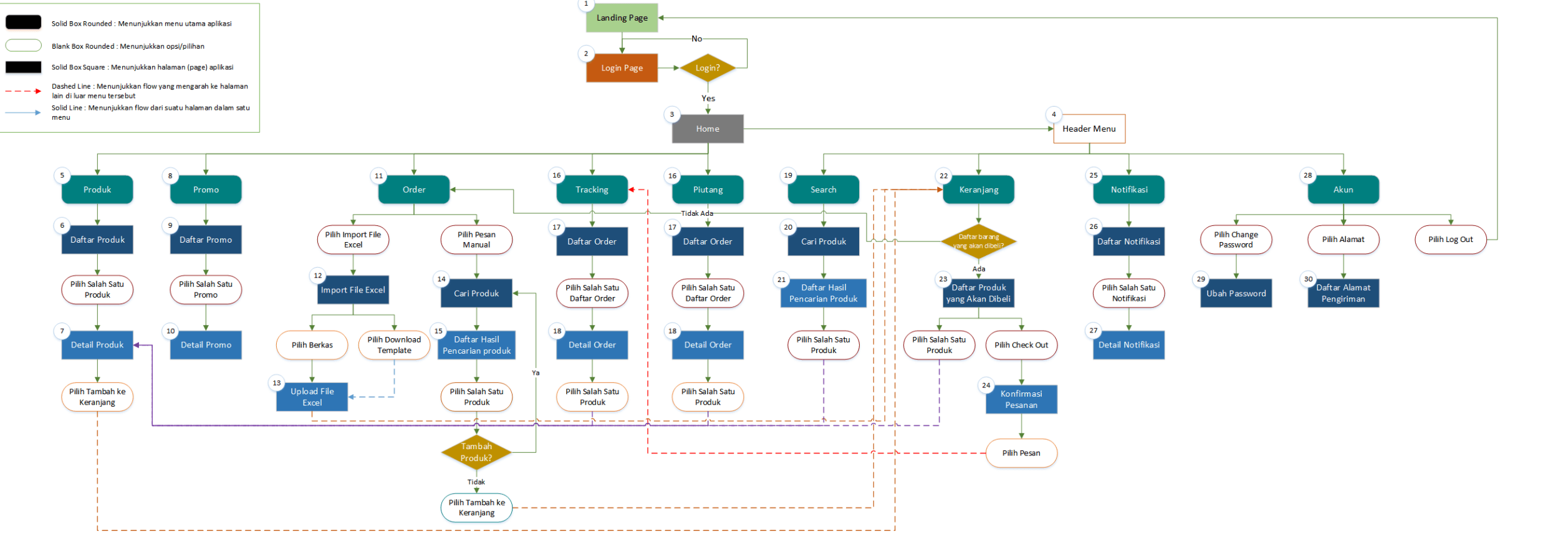
The digitalized sitemap was developed by the Business Analyst, based on initial sketches and insights gathered during the design sprint ideation phase
Phase 3 : Decide
User flows got turned into low-fidelity wireframes, enough structure to test assumptions without committing to visual decisions too early. We reviewed these with the team in rounds, using each pass to catch gaps in the logic and tighten up the interaction patterns before moving forward.
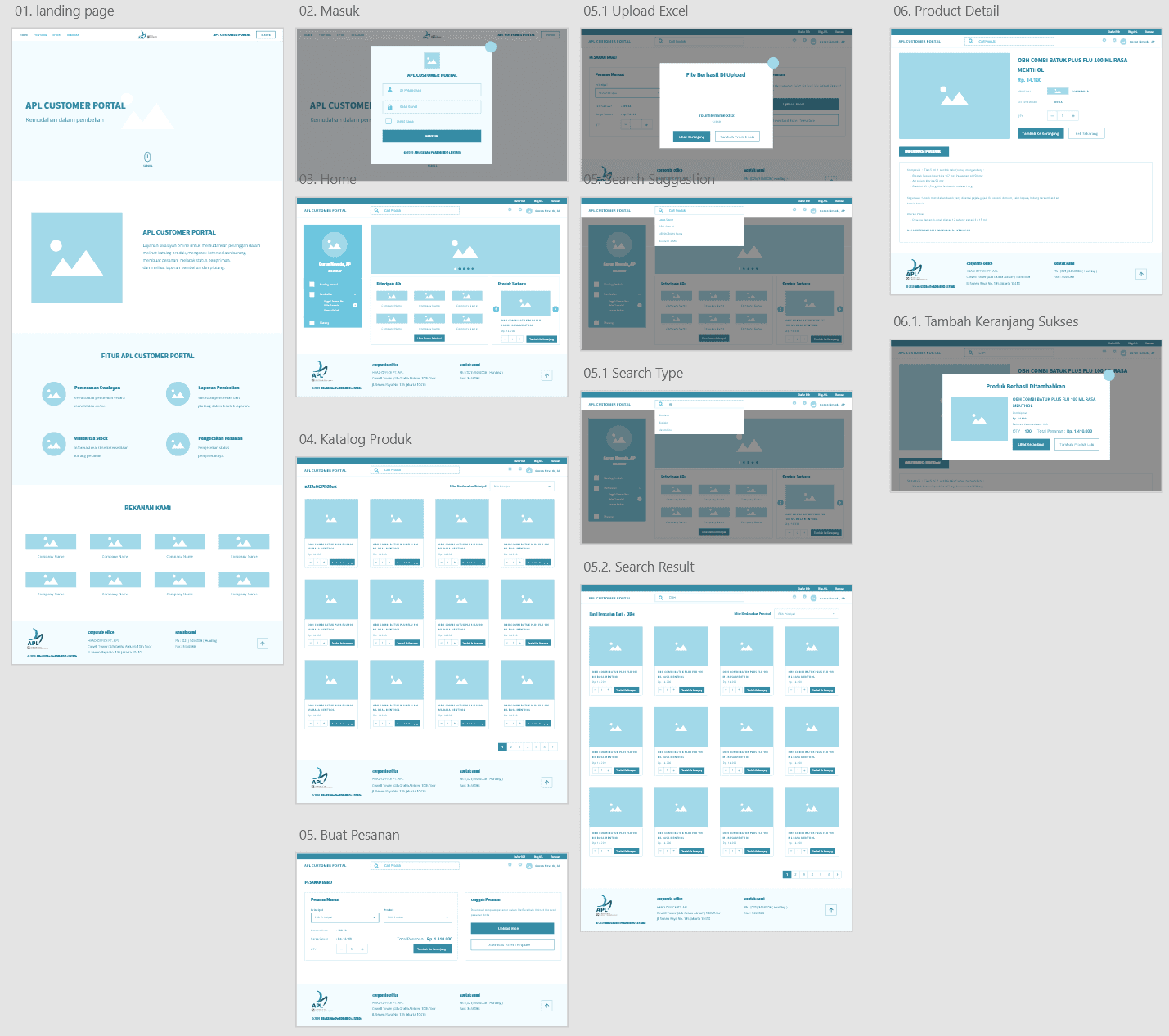
Initial lo-fi design
Phase 4 : Prototyping & Testing
High-fidelity design came next, working across web and mobile in parallel. The two platforms couldn't be treated as mirrors of each other. A web interface built for a desktop browser behaves differently from a mobile app used on the shop floor. Navigation, hierarchy, and layout were each adapted to suit how users would actually interact with the platform on each device, while keeping the visual language consistent enough that switching between them felt seamless.
Phase 5 : Validation, Handover and Finalize
Clickable prototypes in Adobe XD let us put the designs in front of users and see where things held up and where they didn't. Feedback from those sessions fed back into the final designs before anything went to development. Once locked, I worked directly with the front-end team during build to make sure the implementation stayed true to the design intent.

What did we build?
A cross-platform B2B marketplace that gave APL's customers full control over their orders, and gave APL's teams a clearer view of their operations.
The platform launched with four core capabilities:
Sales Ordering: A structured order flow that accommodated both standard item-by-item purchasing and Excel bulk uploads, with the latter feeding into a cart-style review before submission
Order & Delivery Tracking: Step-by-step status updates from order confirmation through to delivery, visible directly in the platform without needing to contact a sales rep
Stock Information: Real-time inventory data so customers could check availability before placing orders, reducing back-and-forth and failed orders
Payment Confirmation: A clear payment flow integrated into the post-order experience
The platform reduced APL's internal reliance on manual coordination and gave their customer base a consistent, self-serve experience across Android, iOS, and web.
What happened after launch
The project didn't end at launch. eZRx went through several rounds of Change Requests, internally scoped enhancement cycles that expanded and refined the platform over time. New features were introduced, including a loyalty program aimed at increasing customer engagement and repeat ordering. My involvement ran through 2022 but the platform continued to evolve until 2024.
Reflection
Digitizing is more than just moving things online
Every decision on this platform involved a trade-off: how much to surface at each step, where confirmation moments should sit, how to introduce digital structure into routines that had been running for years. The Excel bulk upload was one example, but it was one of many we navigated across the platform.
Contributing HTML and CSS during the early sprints also shaped how I approached the rest of the project. Working directly in the early part of the code gave me a more grounded sense of what the front-end team was dealing with, and made my handoffs more precise because of it.
This was also my first experience with a platform that kept growing well past its initial scope. Watching early design decisions grow and become new requirements over multiple years was a different kind of design experience, one that made me much more deliberate about building for flexibility from the start.
Related Projects

