
" height="15.714285714285712px" id="HuUY1YOMY" transform="translate(2 4)" width="20px"/></svg>)
" height="18px" id="smOoqr7Ui" transform="translate(3 3)" width="18px"/></svg>)
EZ Registration: Rebuilding APL eZRx's Customer Verification Process | Case Study
Replacing a manual, multi-channel verification process with a unified digital system that serves both customers and internal approvers across 30+ business types.

Client:
PT Anugerah Pharmindo Lestari (APL)
Category:
Web & Mobile App
My Role:
UI/UX Designer
Tools
Figma, Figjam, Draw.io
A registration system built for two sides of the same process.
APL eZRx gave pharmaceutical distributors a digital space to place orders and manage deliveries. But before any customer could use it, they needed to be verified. Their business licenses had to be checked, their documents reviewed, and their account approved by APL's internal team. EZ Registration was built to handle exactly that.
My Role & Scope
I was the sole designer on this project, responsible for both the customer-facing registration flow and the internal CMS used by APL's approval team. I led the Design Sprint process, facilitated requirements gathering sessions with the Business Analyst, and worked closely with the development team through to handoff. I also built the design system used across the project, adapting Metronic's CMS components to align with APL's brand and the system's specific needs.

What's the issue?
A growing customer base managed through paper forms and group chats, with no way to track where any registration stood.
APL had no monitoring system to track the customer registration process. Documents were collected physically and passed between roles manually. Of 205 customer IDs created between February and May 2024, only 137 documents were traceable at the Jakarta sales office alone. The rest had no clear record.
The paper trail told the rest of the story. From a salesman submitting documents to a customer ID being created took an average of 10 working days. From the BRQA stage alone, it took another 4. Overall, the average lead time for a new customer registration in the Jakarta branch was 9 working days.
For customers, this meant waiting with no visibility into where their application stood or who was handling it. For APL's internal team, it meant chasing paper across roles with no unified place to track progress or flag delays.
Design Process
The project followed a Design Sprint methodology, moving from requirements and flows through to high-fidelity prototypes before anything went to development.
Phase 1 : Understand
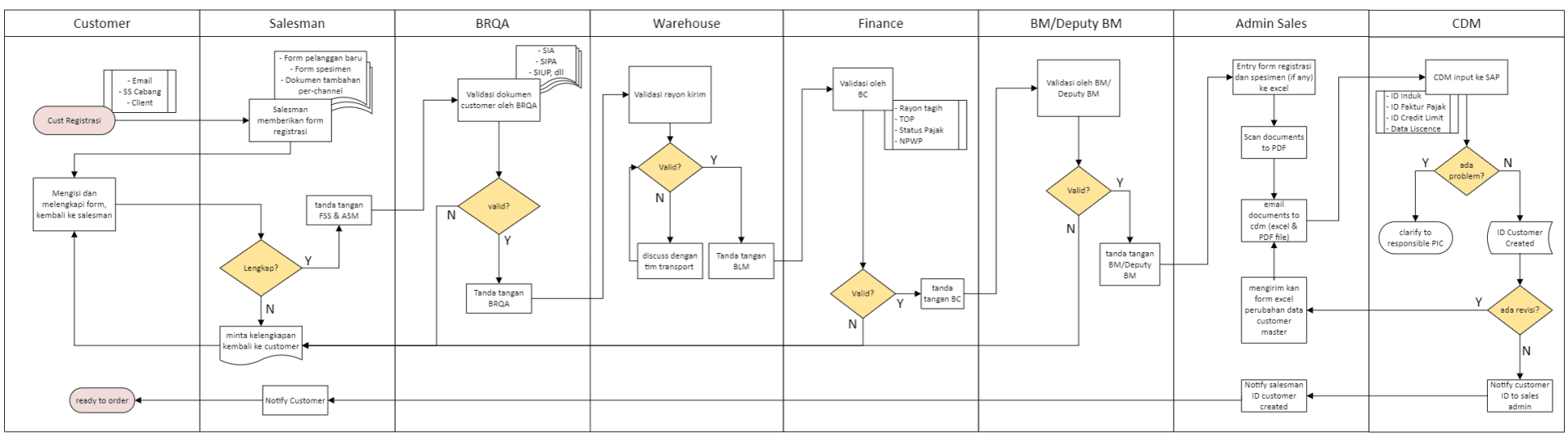
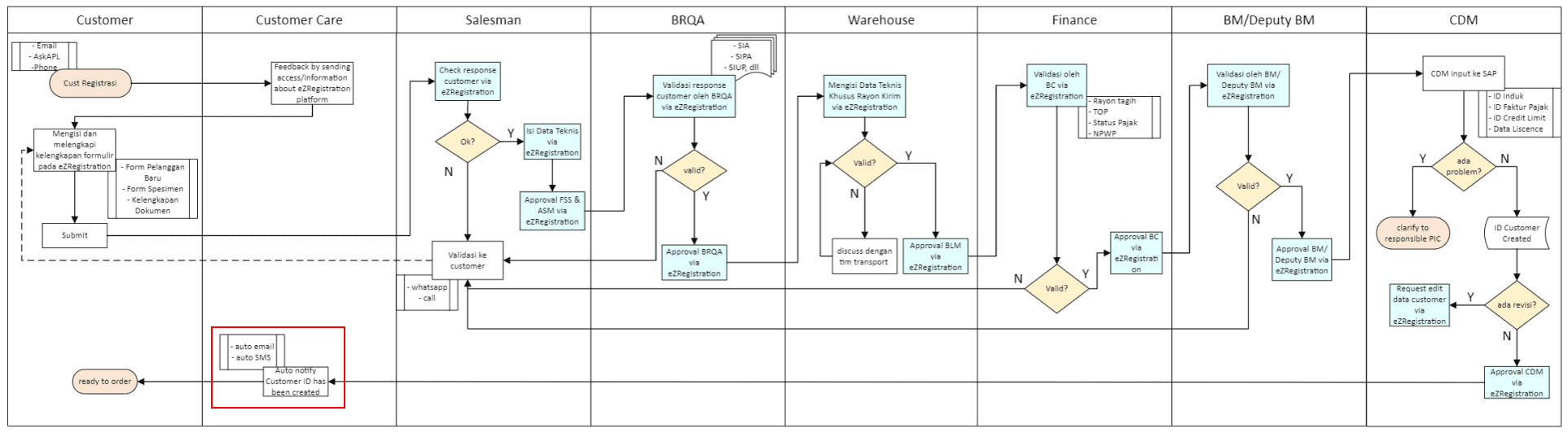
APL's team came in with a clear picture of their existing process. They shared their current registration flow, the expected improved flow, and the document requirements for each business type. Our job was to dig into that material, ask the right questions, and map out what a unified digital system would actually need to handle.
I worked closely with the Business Analyst to go through the requirements for all 30+ business types, using a spreadsheet to map similarities and differences across forms and steps. This early mapping was what made the design phase manageable. Rather than treating every business type as a separate design problem, we could identify where forms could share structure and where genuine variation existed. We also conducted interviews with APL's internal team to understand how approvals actually worked in practice, including the regional differences that were not always visible in the documentation.
Phase 2 : Ideate
Before touching the interface, the team mapped detailed flows for each user role in Draw.io. With a system this complex, involving multiple approval levels, regional variations, and 30+ form configurations, jumping straight into wireframes would have created gaps. Getting the logic right first meant the wireframes would reflect how the system actually needed to behave.
Existing Flow :
Expected Flow :
Low-fidelity wireframes covered both the customer-facing registration flow and the admin-side approval interface. These went through several rounds of review with stakeholders before we locked the direction.
Phase 3 : Decide
One of the more significant process decisions came when we hit the challenge of designing for 30+ business types. Creating a separate prototype for every variation would have been both time-consuming and difficult to maintain. Instead, I maximized Figma's variants and variables to build modular components where similar forms shared a base structure and variation was handled through component properties rather than duplicated frames.
Using Figma's variable modes to define visual properties separately from the structure meant that moving from low-fidelity to high-fidelity still required adjustments, but nowhere near the effort of rebuilding from scratch. The core logic and layout carried through, so the transition was mostly refinement rather than reconstruction.
Phase 4 : Prototype & Validate
High-fidelity prototypes were built in Figma and presented to stakeholders for review. This phase was about confirming that the design held up against real requirements before anything went to development. Feedback from these sessions fed back into the final designs, ensuring the flows were intuitive and the logic was sound for both the customer-facing side and the admin CMS.
Phase 5 : Handover & Iteration
Once the designs were validated, I worked directly with the front-end and back-end teams through the build. The component system built in the early stage made the handoff more precise, giving developers and QA engineers a consistent, well-documented set of components to reference. As development progressed, I stayed involved to make sure the implementation stayed true to the design intent and to address any gaps that came up during build.

What did we build?
A fully digital registration system covering both sides of the process, built to scale with APL's growing customer base.
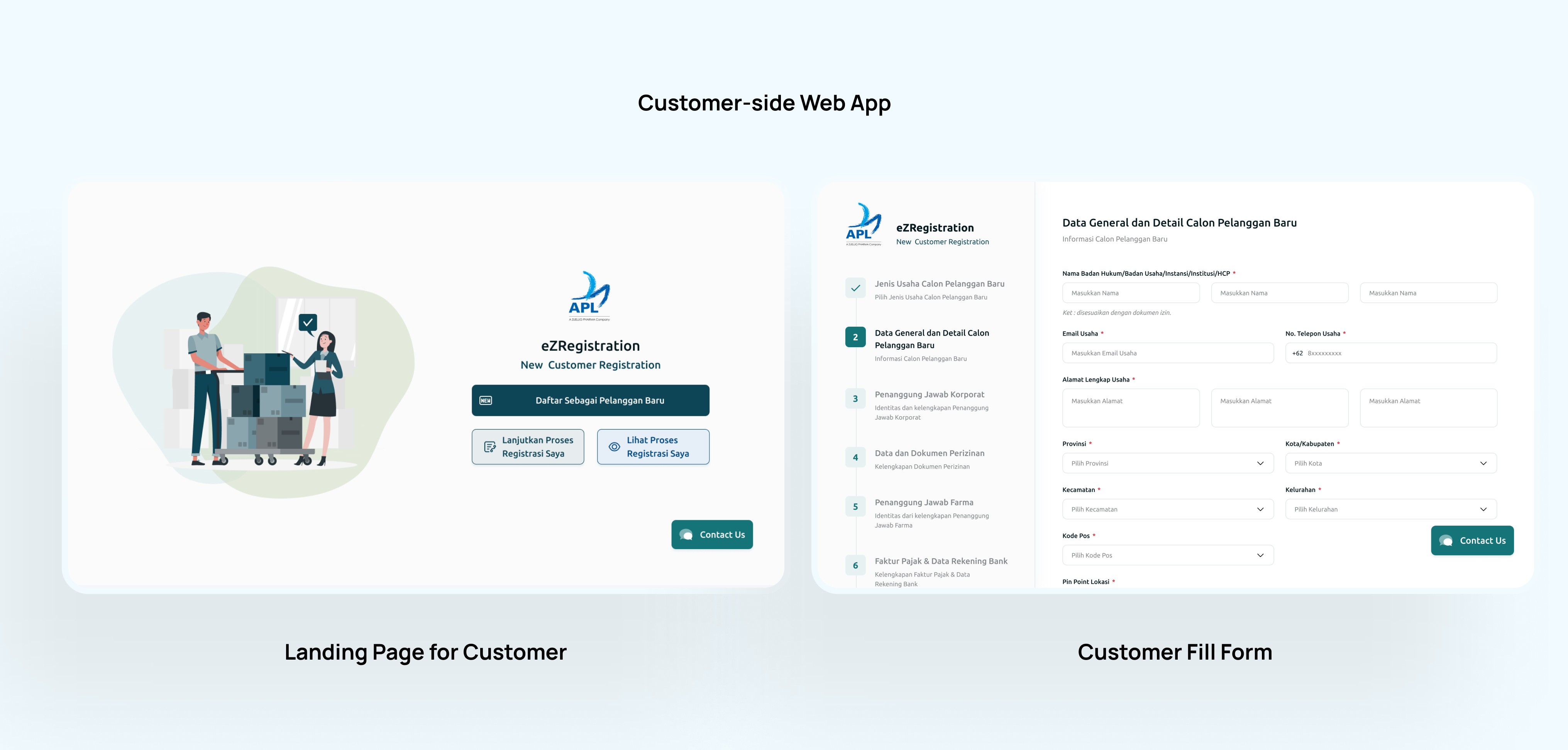
On the customer side: a structured registration flow that adapted to each business type, a document submission experience that guided users through exactly what was needed, a progress tracking interface accessible without logging in by entering a registration number, email, or phone number, and a revision flow that brought customers back only to the specific step that needed attention rather than the beginning of the form.

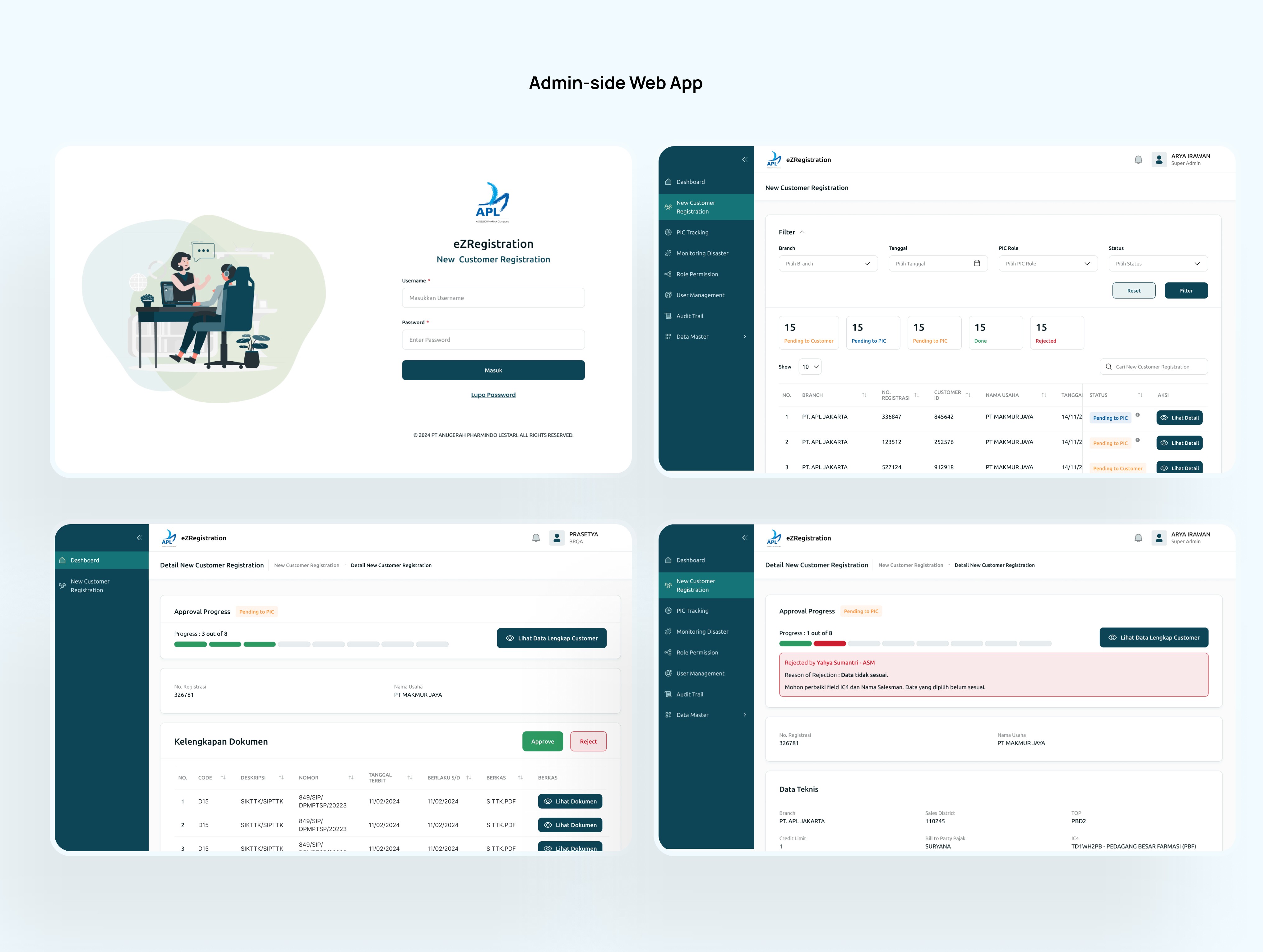
On the admin side: a CMS for managing and approving registrations across multiple roles and approval levels, with visibility into where each application stood, the ability to leave detailed notes at any step, and the option to reject a submission back to the customer or forward it to another staff member for review.
Notifications via web, email, and WhatsApp kept both sides informed throughout the process.
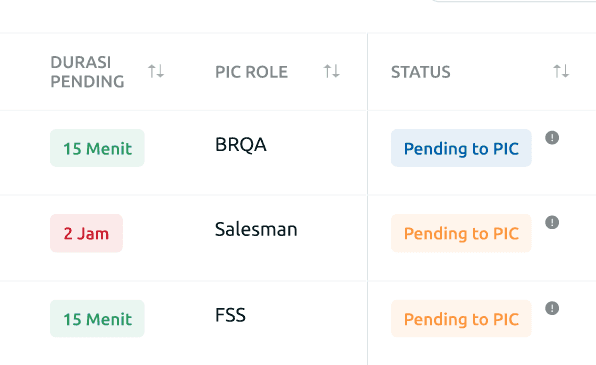
To support the SLA target, the admin side included a pending duration column on the approval dashboard. Each registration displayed how long it had been waiting at its current approval step, with a color-coded warning system that escalated visually as time passed. Once a registration exceeded 30 minutes without action, the system automatically sent a reminder notification to the relevant approver. This kept the approval chain moving without requiring manual follow-up, and gave team leads visibility into where delays were accumulating.
What happened after launch
The approval process that previously took weeks was reduced to under 30 minutes after launch. Customers gained full visibility into their registration status without needing to contact anyone. APL's internal team moved from managing registrations across WhatsApp and email to a single structured system with clear ownership at every step.
EZ Registration also completed the eZRx ecosystem. Customers could now move from first contact with APL through to placing their first order entirely within a connected digital experience.
Reflection
Designing at scale means getting the structure right before the details
Building the component system in Figma before the design was fully resolved was the most demanding part of this project, and also the one that paid off most clearly. It would have been faster in the short term to design each business type separately and clean it up later. But with 30+ variations and a tight timeline, inconsistencies introduced early would have compounded through every subsequent phase. Getting the structure right in components, and using variable modes to carry that structure from low to high fidelity, kept the design coherent at a scale that would otherwise have been difficult to manage.
The regional approval variation was a useful reminder that real organizational processes rarely follow a single clean path. Designing for the exception is not a special case. It is part of designing for how things actually work.
Related Projects

